How to write an ideal customer profile for a solo SaaS
How to write an ideal customer profile for a solo SaaS: one plain sentence, problems in your customer's words, and a one-week test on X.
Here is how to write an ideal customer profile for a solo SaaS. Start with one plain sentence about who you help. Add 3 to 5 problems in your customer's own words. Write one line about what you sell. Then test it with real X searches for one week.
You do not need a customer list, a sales team, or paid research. You need a clear guess that you can check against real posts.
An ideal customer profile, or ICP, is a short description of the person most likely to need and pay for what you built. For a solo founder, it fits on one card.
The one-page ICP card (fictional example). The product, Nudgebill, is made up for this guide.
| Part | What to write | Fictional example |
|---|---|---|
| Who you help | One sentence: who, situation, trigger | Freelance designers who bill by the project and just had a client pay late |
| Problems in their words | 3 to 5 short phrases | "client hasn't paid", "how do I chase an invoice", "awkward to ask for payment" |
| What you sell | One line that names the fix | Polite invoice reminders that send themselves |
The rest of this guide shows how to fill in each part, step by step.
What an ideal customer profile means when you are one person
In a big company, an ICP is often a long document. It helps a sales team decide which companies to call first.
When you work alone, your ICP has a smaller job. It tells you who to look for and which words to search. That is it.
Think of it as a working guess. You write it today. You check it this week. You change it when the posts you find tell you something new.
Why the big-company ICP templates do not fit a solo SaaS yet
Many ICP templates are written for sales teams that already have customers. They often ask you to study your best accounts and sort them into groups.
They also lean on firmographics. Firmographics are facts about a company, such as its size, industry, and yearly revenue. These help when you sell to businesses at scale. They help less when you have two users and want your first ten.
| Sales-team ICP | Solo-founder ICP | |
|---|---|---|
| Starts from | Existing customer data | A guess about one kind of person |
| Main details | Company size, industry, revenue bands | One sentence, pain phrases, one offer line |
| Used for | Ranking leads in a sales tool | Choosing what to search for and who to help |
| How it is checked | Deal reports over months | Real posts over one week |
| Length | Often several pages | One card |
So skip the template for now. You can add firmographics later, once you have customers to study.
Step 1: Write the one-sentence ICP (who, situation, trigger)
Use this simple formula:
[Who] who [situation] and [trigger].
- Who is the kind of person. Use a job, a role, or a hobby.
- Situation is what is true about them right now.
- Trigger is the moment the problem shows up. This is when they start looking for help.
Example (fictional): "Freelance designers who bill by the project and just had a client pay late."
The trigger matters most. A designer who has never been paid late does not need Nudgebill today. A designer waiting on a late payment might.
Keep the sentence short. If you need two sentences, you may be describing two different customers. Pick one for now.
Step 2: List the problems in your customer's words, not your landing page's words
Your landing page might say "automated accounts receivable workflows." No tired freelancer types that.
Write how the person would say the problem out loud, or type it late at night. Aim for 3 to 5 phrases to start.
Example phrases (fictional):
- "client hasn't paid"
- "how do I chase an invoice"
- "awkward to ask for payment"
- "invoice overdue again"
Short phrases are easier to search. If you are not sure of the words, think about the last time you had the same problem. What did you type?
Step 3: Write what you sell in one line that names the fix
This line connects the problem to your product. It should name the fix, not list features.
- Weak: "An all-in-one billing platform for creatives."
- Better: "Polite invoice reminders that send themselves."
A good test: could the person from Step 1 read your line and say, "Yes, that is my problem"? If not, rewrite it.
Worked example: from vague to sharp
Here is the same fictional ICP before and after the three steps.
| Part | Vague (before) | Sharp (after) |
|---|---|---|
| Who | Small businesses | Freelance designers |
| Situation | Who need better finances | Who bill by the project |
| Trigger | None | Just had a client pay late |
| Pain phrases | "cash flow management" | "client hasn't paid", "how do I chase an invoice" |
| Offer line | All-in-one billing platform | Polite invoice reminders that send themselves |
The vague version could mean almost anyone. The sharp version tells you exactly what to search for this week.
Step 4: Test the ICP on X with real searches this week
Now check your guess. Turn each pain phrase into a search with the free X search builder. Each field of the builder writes one operator. (X search builder) An operator is a short bit of text that adds a rule to a search, such as which words to leave out.
Adding a question mark operator to a query finds posts with a question mark: people who ask something. (X search builder) Those posts are often the best place to start.
Example: the builder filled with a fictional phrase from a different niche (candle pricing).
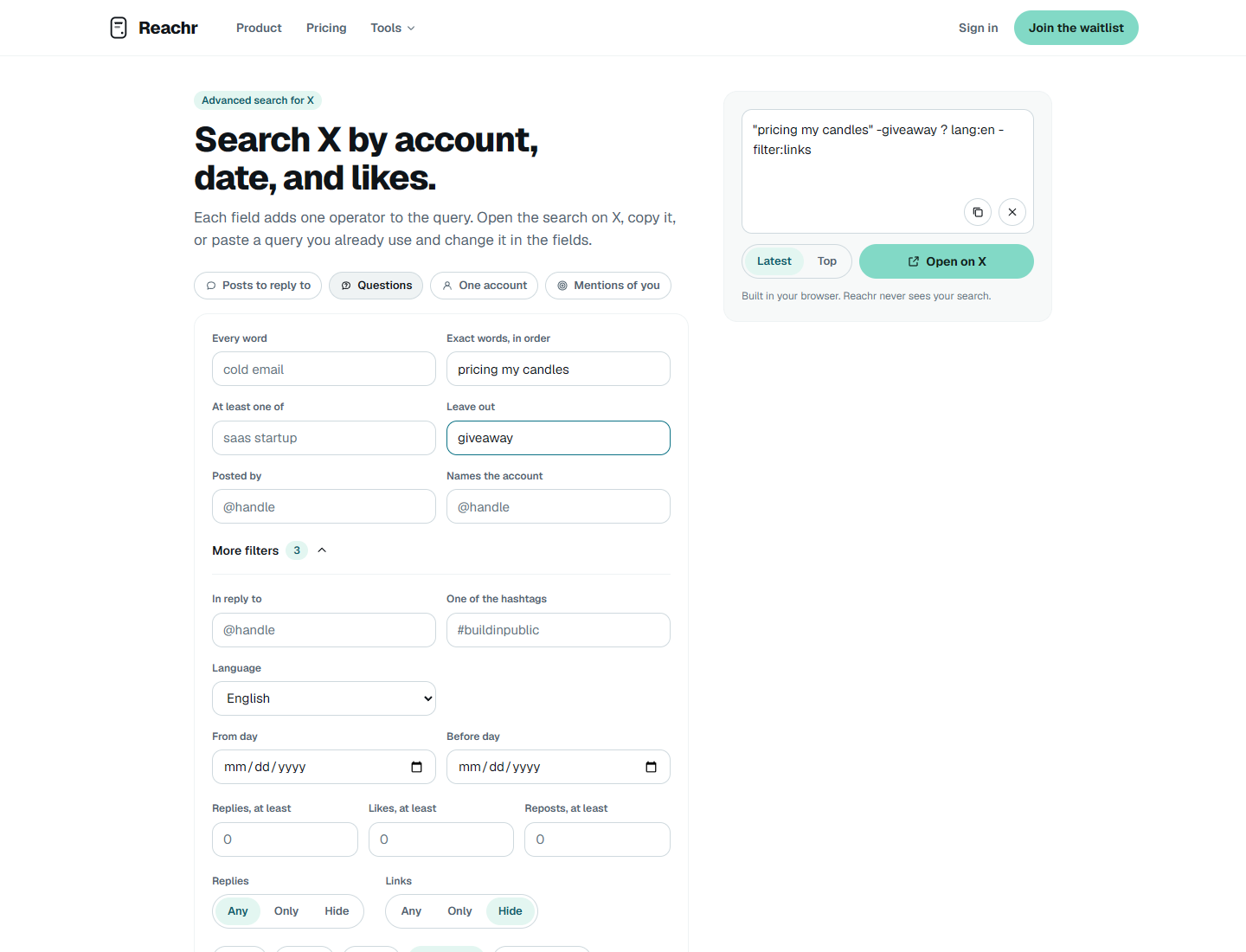
This screenshot shows the builder, not live X results. For that example, the builder produced this query:
"pricing my candles" -giveaway ? lang:en -filter:links
For the Nudgebill example, you might try a query like "client hasn't paid" ? lang:en. This is a fictional example. Open it on X and read what comes back.
For one week, run 3 to 5 searches each day, one per pain phrase. For each search, ask:
- Are these the people from my one sentence?
- Do they describe the problem in words like mine?
- Would my product actually help them?
If you want a full daily routine for this, see Social listening for solo founders.
Signs your ICP is too broad or too narrow
Your searches will tell you which way to adjust. Use this table as a general guide.
| What you see | What it may mean | What to try |
|---|---|---|
| Many posts, but most are from the wrong people | Too broad | Narrow the "who" or add a clear trigger |
| The right people, but they talk about other problems | Wrong pain phrases | Rewrite the phrases in words they actually use |
| Almost no posts at all | Too narrow, or a strict search | Use broader phrases or remove one filter |
| The right people with the right problem | Close to right | Keep it and start replying with real help |
When a search returns nothing, one filter is usually too strict. (X search builder) Remove one and try again.
Also remember that X search is not a full archive. It leaves out deleted posts, posts from protected accounts, and posts from accounts that X limits. (X search builder) A quiet search does not always mean nobody has the problem. If you still find very little after a week, your customers may talk somewhere else, such as a forum or community.
Keep a simple log and revise the ICP every few weeks
Keep a plain spreadsheet. Add a row each time you find a good post.
- Date
- Which search found it
- Link to the post
- Did the person match your one sentence?
- Did you reply, and did they answer?
If you also track signups, count a waitlist signup as a lead. Track paying customers in a separate column.
After two or three weeks, read the log. Which phrases found the right people? Which ones found noise? Update your card. Change one part at a time, so you can tell what helped.
When a tool helps
The manual test works. But running the same searches every day takes time. That is the part we are building Reachr to help with.
Reachr finds posts on X about problems a user's product solves and drafts replies for the user to edit. Reachr can also score drafts and schedule posts that the user approves. (Reachr home page)
You still choose who to reply to and what goes out. If you would like to try it when it opens, you can Join the waitlist. The steps above still work on their own.
FAQ
Is an ICP the same as a buyer persona?
Not quite. A buyer persona is a made-up character that stands for one type of customer, often with a name and a backstory. An ICP is shorter. It says who is most likely to need and buy your product. For a solo founder, the one-sentence ICP is usually enough.
How do I write an ICP with zero customers?
Start with a guess. Use the who, situation, and trigger formula. Then test it with real searches. Posts from people with the problem act like early customer research.
How specific should my ICP be?
Specific enough that you know what to search for. If your sentence could describe almost anyone, it is too broad. If your searches find almost nothing for a week, it may be too narrow.
How often should I change my ICP?
Look at your log every few weeks. Change it when the posts you find show a better group of people or better words. Change one part at a time.